La familia y el genero de las palabras: Nivel A1_2b
La familia: family in Spanish

Unit 2a focuses on how to talk about family in Spanish, using personal questions, numbers, and how to form the plural of nouns. Once you’ve finished the lesson, practice what you’ve learned with these interactive word games. They’re organized into four groups: Family in Spanish. Spanish numbers from 0-100. Questions about family in Spanish. The … Leer más
CRUCIGRAMAS: CONJUGACIÓN DEL PRESENTE DE INDICATIVO

15 crucigramas para dominar el presente de indicaativo

Aquí tienes algunos crucigramas para practicar la conjugación del PRESENTE en español. Primero, vamos a trabajar con los verbos regulares, terminados en -AR y en -ER y -IR, para continuar con los diferentes grupos de verbos irregulares. Presente de indicativo de los verbos regulares terminados en -AR Empezamos con los verbos terminados en -AR, los … Leer más

Mini test del SUBJUNTIVO, para descubrir cuánto sabes

Mini-Test sobre el subjutivo

En la entrada de hoy, te proponemos un mini test del subjuntivo para comprobar cuánto sabes sobre este tema, fundamental para la mayoría de los estudiantes de español como lengua extranjera de nivel intermedio. De ahí que hayamos publicado más de 20 entradas relacionadas con este tema. Las tenemos tanto para conjugar los diferentes tiempos del … Leer más

Spanish verbs with FIRST PERSON IRREGULAR «YO»

First person irregular

This group of irregular verbs is super easy — but very important! These verbs are special because ONLY the first-person singular (yo) form is irregular. All the other forms are completely regular. To make them easier to learn, we can organize them into three mini-groups: 1. Verbs that don’t follow any specific pattern: Dar (to … Leer más

6 ejercicios con los PRONOMBRES DE SUJETO

6 Ejercicios con pronombres de sujeto

Hoy te presentamos 6 ejercicios con los pronombres de sujeto (pronombres personales de sujeto) en español. Un tema básico pero que debes controlar bien desde el principio. Haz clic aquí si quieres ir directamente a los ejercicios interactivos.  ¿Cuáles son los pronombres de sujeto? Aquí tienes una tabla con los pronombres de sujeto. Recuerda que … Leer más

CRUCIGRAMAS: CONJUGACIÓN DEL IMPERATIVO AFIRMATIVO

Aprende la conjugación del imperativo afirmativo con crucigramas

Aprender el uso del imperativo es fundamental en español para poder comunicarte de manera natural, ya que no solo se utiliza para dar órdenes, sino también para dar instrucciones, dar consejos, invitar o llamar la atención.  En la lección de hoy vamos a practicar la conjugación del imperativo afirmativo con crucigramas. Haz clic en el … Leer más

Verbs TENER and HABER: to ways to say to have

Verbos TENER y HABER

Today, we are going to clarify one of the most common doubts when learning Spanish: when do we use the verbs TENER and HABER? Although they may sometimes seem similar, they can actually be translated as «to have», but they have very different functions and are used in other contexts. In the video below, you … Leer más

OJALÁ para expresar deseos con el SUBJUNTIVO

OJALÁ para expresar deseos.

La palabra «ojalá« es una interjección exclamativa que se usa para expresar deseos en pasado presente o futuro. Hay que utilizarla siempre verbo en el modo subjuntivo Proviene de la expresión árabe In šāʾ Allāh (إن شاء الله), que significa «si Dios quiere». ¡Veamos cómo se usa correctamente! Cómo usar «Ojalá» en español: Significado, reglas y … Leer más

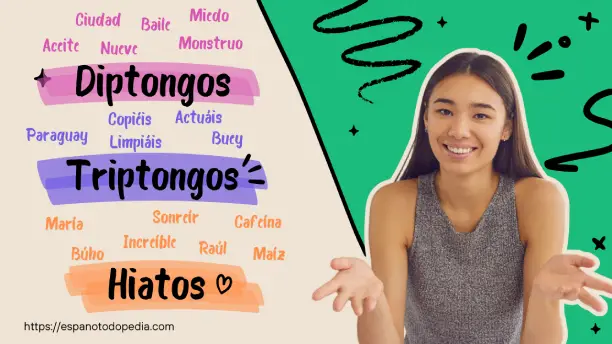
Spanish diphthongs, triphthongs and hiatos (A2)

diptongos, triptongos e hiatos en español

Do you know what Spanish diphthongs are? In this lesson, we will learn how to pronounce correctly when there are two or more vowels in the same syllable, as you probably have already noticed, which happens very often in Spanish. First, look at the example on the right, the difference between a syllable and a diphthong, … Leer más

error: Content is protected !!